Thursday, August 27, 2009

"Hymns of Exaltation" is Finished


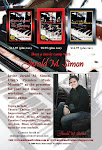
"Hymns of Exaltation" by Jerald M. Simon ($13.95 plus tax)
To purchase a copy of "Hymns of Exaltation", please visit www.shop.musicmotivation.com, or your local music store. If your local music store is not yet carrying Music Motivation® products, they may contact Music Motivation® at: P.O. box 1000, Kaysville, UT 84037-1000 or mailto:retail@musicmotivation.com.
I have finished my sixth book, "Hymns of Exaltation". I hope you enjoy listening to these arrangements. I had a wonderful time arranging each hymn and I am delighted to share them with you. I wanted to arrange each of these hymns because the melodies and lyrics mean so much to me. I will be coming out with a CD of the arrangements shortly. I'd love to hear your feedback about the hymns. I will soon be working on a new book of hymn arrangements as well. Please feel free to email me with any suggestions of hymns you'd like arranged by clicking here. Thanks. I look forward to your comments.

To begin listening to the songs, I recommend turning off the widget player on the right side of the blog. When you first come to the blog, the widget player automatically begins to play music. Scroll down until you see the widget player (which is right below the "Sign up below for our FREE Monthly Music Motivation® Newsletter" spot - three down from the top and above the "Do You Play a Musical Instrument" survey) and press the play/pause button to pause or stop the music. The widget player has my name at the top and a picture of the book Sea Fever below my name. The first song playing is Gray Dawn Breaking from Sea Fever. Begin listening to each individual hymn arrangement by pushing the play button below the example of each individual song.

This is the first page of "For the Beauty of the Earth" from Hymns of Exaltation.


This is the first page of "Be Still My Soul" from Hymns of Exaltation.


Listen to the arrangement below.

Click above to listen to "Be Still My Soul" arranged by Jerald M. Simon

This is the first page of "Nearer My God to Thee" from Hymns of Exaltation.


Listen to the arrangement below.

Click above to listen to "Nearer My God to Thee" arranged by Jerald M. Simon

This is the first page of "I Stand All Amazed" from Hymns of Exaltation.


Listen to the arrangement below.


Click above to listen to "I Stand All Amazed" arranged by Jerald M. Simon


This is the first page of "Abide With Me" from Hymns of Exaltation.

Listen to the arrangement below.


Click above to listen to "Abide With Me" arranged by Jerald M. Simon


This is the first page of "I Need Thee Every Hour/Lead Kindly Light" from Hymns of Exaltation.

Listen to the arrangement below.

Click above to listen to "I Need Thee Every Hour/Lead Kindly Light" arranged by Jerald M. Simon

This is the first page of "More Holiness Give Me" from Hymns of Exaltation.


Listen to the arrangement below.


Click above to listen to "More Holiness Give Me" arranged by Jerald M. Simon

This is the first page of "I Heard the Voice of Jesus" (also known as "O Sing a Song of Bethlehem", and "If You Could Hie to Kolob") from Hymns of Exaltation.

Listen to the arrangement below.


Click above to listen to "I Heard the Voice of Jesus" (also known as "O sing a Song of Bethlehem" and "If You Could Hie to Kolob") arranged by Jerald M. Simon

To purchase a copy of "Hymns of Exaltation", please visit www.shop.musicmotivation.com, or your local music store. If your local music store is not yet carrying Music Motivation® products, they may contact Music Motivation® at: P.O. box 1000, Kaysville, UT 84037-1000 or retail@musicmotivation.com for the distributors' contact info. Or, if they would like to contact the distributor directly, they may contact Chesbro Music Co. at 1.800.243.7276. The product number for "Hymns of Exaltation" is MM00001007. The ISBN is 978-0-9790716-5-2. If you have more questions or would like to know more, email Music Motivation® at info@musicmotivation.com.


Written by Jerald M. Simon

Copyright © 2009 Music Motivation®

All Rights Reserved


Monday, July 6, 2009

"Hymns of Exaltation" by Jerald M. Simon


"Hymns of Exaltation" by Jerald M. Simon - $13.95


I am almost finished with my 6th book, "Hymns of Exaltation". There are 8 songs in the book:

(1). "For the Beauty of the Earth", (2). "Be Still My Soul", (3). "Nearer My God to Thee", (4). "I Stand All Amazed", (5). "Abide With Me", (6). "I Need Thee Every Hour/Lead Kindly Light", (7) "More Holiness Give Me", and (8). "If You Could Hie to Kolob".

I tried to pick songs that were well known Christian songs - familiar to the majority of Christian religions. In a few months, I will come out with the CD of the arrangements. I am in the process of outlining several hymn arrangement books to be done in the next year and would love to find out which hymns you personally would like arranged. Feel free to email me with your suggestions and comments. I look forward to hearing from you.

Written by Jerald M. Simon
Copyright © 2009 Music Motivation®
All Rights Reserved

Tuesday, June 9, 2009

Composing 101

Anyone can write music! Some people think composers only write music when they are inspired. That is true, but composers who only write music when they receive inspiration limit themselves and their creativity. Many composers receive even more inspiration when they begin constructing a composition using theory as their core structure. It empowers and enables them to envision the composition at each stage of its creation because they use their understanding of intervals, chords, scales, and progressions to perfect their musical ideas. As a result of their theoretical ingenuity, their inspiration increases.

A good composition requires the use of music theory to mold everything together. To anyone who does not understand the theory of music or who feels less than qualified to utilize it, I encourage you to learn it. Do it. Jump into the world of music theory. Jumping into the unknown is the most frightening part. Once you jump you're free falling and gravity takes it course (in a way that sounds like you'll die on impact, but honestly you won't). Every great composer understands how music is created, what segments and parts make the whole complete and how to take a simple melody and make it into a musical masterpiece. Harmonies are added and the form takes shape. Rhythm is an intricate part of music and composers use it to their advantage.

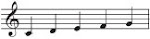
For fun, lets try writing a simple (when I say simple, I mean very simple) song - in this example it will be a melody. We'll use the notes C, D, E, F, and G (this is the C major penta-scale because it is the first five notes from the C major scale).

All good compositions begin and end on the chord or with the note after which the key signature is named, unless the song is written in a mode - in which case it would begin on the note of the individual mode.

Since we're in the key of C, we'll begin on the C note. We'll start with a right hand melody. The easiest way to teach composition is to assign each of the letters (C, D, E, F, and G) to a number. In this case we will number them 1 (C) 2 (D) 3 (E) 4 (F) and 5 (G) (which also happens to be the fingering for the right hand). I like to have students come up with any random, and I mean random, order of notes. The only rule is to begin and end on C (or 1 in this case). Here we go...

These are random numbers beginning and ending on 1 (using the numbers 1 - 5).

Our number sequence is 1, 4, 2, 3, 5, 4, 3, 2, 1. The letters that correspond with the numbers are: C, F, D, E, G, F, E, D, C. Below I've included the musical notes that correspond to each of the numbers. The notes are quarter notes.

Now I've taken the same notes but have changed them to eighth notes.

Once you feel comfortable doing this with five notes you can apply the same technique to all of the notes from the scale (start with the key of C major to begin with). After using whole notes, half notes, quarter notes, and eighth notes individually, try using them together. This is an example of the same notes as above, but now the rhythm is mixed.

Composing is such a wonderful way to share your ideas. In the beginning, you may not receive inspiration. Angels may not sing to you and tell you which notes to write (I'm still waiting for that one to happen to me too). Understanding and using music theory will enable you to create melodies and harmonies which will inspire you to continue creating more and more music. Your music will inspire you, but more important, it will inspire those who listen to it.

Good luck composing. It's a wonderful skill to learn and anyone can do it. As a matter of fact, everyone should do it. You learn so much as you create music of your own and others learn a great deal about you through the music you've created.

I do composition workshops, seminars, and music camps with music teachers and their students and I can tell you everyone can compose. You don't need to be an Einstein or even the next Mozart. All you have to be is you. What you bring to the table is so important because you bring your experiences, your likes, dislikes, view of the world around you, etc. Everything you do shows forth in your music. Start writing now! Who knows, maybe you will be the next Mozart. Maybe your compositions will change the world. Until you start creating you'll never know.

Written by Jerald M. Simon
Copyright © 2009 Music Motivation®
All Rights Reserved

Saturday, May 9, 2009

Sea Fever


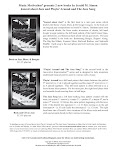
I recently finished my fifth book, "Sea Fever" The book contains 10 original piano solos I have written which were inspired by the poem Sea Fever written by John Masefield. The book is broken down into 10 individual lessons - one for each of the 10 songs (1) "Sea Fever", (2) " I Must Go Down to the Seas Again", (3) "The Lonely Sea", (4) "The Wind's Song", (5) "Gray Mist", (6) "Horizon", (7) "A Star to Steer Her by", (8) "Buried Treasure", (9) "Tempest-Tossed", and (10) "Gray Dawn Breaking".

I have included a sample page, the first page, from each of the 10 songs from the book. I will be recording the songs so they can be heard as well. Eventually I will produce a CD with each of the 10 songs from the book. Let me know what you think of the sample pages. The book retails for $13.95 and may be purchased online at www.musicmotivation.com, or from your local music store.

This is the sample page for the song
"Sea Fever".


This is the sample page for the song
"I Must Go Down to the Seas Again".


This is the sample page for the song
"The Lonely Sea".

This is the sample page for the song
"A Star to Steer Her by".

This is the sample page for the song
"The Wind's Song".

This is the sample page for the song
"Gray Mist".

This is the sample page for the song
"Horizon".

This is the sample page for the song
"Buried Treasure".

This is the sample page for the song
"Tempest-Tossed".

This is the sample page for the song
"Gray Dawn Breaking".


If you would like to purchase "Sea Fever", visit your local music store. The book is $13.95. If your local music store is not yet carrying Music Motivation® products they may contact my company Music Motivation® at info@musicmotivation.com for the distributors' contact info. Or, if they would like to contact the distributor directly, they may contact Chesbro Music Co. at 1.800.243.7276. The product number for "Sea Fever" is MM00001005. The ISBN is 978-0-9790716-4-5.

Written by Jerald M. Simon

Copyright © 2009 Music Motivation®
All Rights Reserved

Wednesday, February 25, 2009

"Jazzed about Jazz" workshop


I recently did a workshop at Bountiful Music, a music store in Bountiful, Utah (www.bountifulmusic.com/), on my latest book, "Jazzed about Jazz (jazz, blues, and boogie woogies for the intermediate piano student)". Two of my piano students, Steven Ward (age 14) and Nate Campbell (age 12), played my compositions from the book for those attending the workshop.

This is a sample page from the first page of the first song, "Boomerang Boogie", in the book "Jazzed about Jazz". It's a fun upbeat song.


This is the clip of one of my piano students, Steven Ward (age 14) playing, "Boomerang Boogie". I wrote "Boomerang Boogie" to help students learn left hand boogie woogie patterns. The right hand plays several variations of the blues scale, and various 7th and 9th chords in different inversions.

This is a sample page from the first page of the second song, "Skippin' Along", in the book, "Jazzed about Jazz".


This is the clip where I play the song, "Skippin' Along" (one of my piano students, Nate Campbell, age 12, demonstrates the lesson that preceeds the song). I wrote "Skippin' Along" to present a progression of 7th chords descending in 5ths and played in root 1st, 2nd, and 3rd inversions.

This is a sample page from the first page of the third song, "The Sidewalk Shuffle", in the book, "Jazzed about Jazz".


This is the clip of Nate Campbell (age 12) playing, "The Sidewalk Shuffle". I wrote "The Sidewalk Shuffle" to help students learn three left hand shuffle patterns and the chromatic scale (the half step scale).

This is a sample page from the first page of the fourth song, "Summer Skies", in the book, "Jazzed about Jazz".


I wrote "Summer Skies" to teach all of the 7th chords moving up diactonically (according to major scale) in any given key signature. I named the song after my little girl, Summer. I didn't film anyone playing this song at the workshop so there isn't a video of the song being performed. I will post one soon.

This is a sample page from the first page of the fifth song, "Railroad Ruckus", in the book, "Jazzed about Jazz".


This is the clip of Nate Campbell (age 12) playing, "Railroad Ruckus". I wrote "Railroad Ruckus" to help teach the left hand blues pattern of a perfect 5th, major 6th, minor 7th, and returning back to the major 6th interval, and the blues scales beginning on C, F, and G.

This is a sample page from the first page of the sixth song, "The Big Bad Blues" in the book, "Jazzed about Jazz".

This is the clip of Steven Ward (age 14) playing, "The Big Bad Blues". I wrote "The Big Bad Blues" to introduce students to a blues left hand pattern, crushed notes (played simultaneously with the following note and released immediately), and the tremolo (alternating rapidly between two notes or chords).

If you would like to purchase "Jazzed about Jazz - jazz, blues, and boogie woogies for the intermediate piano student", visit your local music store. The book is $11.95. If your local music store is not yet carrying Music Motivation® products they may contact my company Music Motivation® at info@musicmotivation.com for the distributors' contact info. Or, if they would like to contact the distributor directly, they may contact Chesbro Music Co. at 1.800.243.7276. The product number for "Jazzed about Jazz" is MM00001004. The ISBN is 978-0-9790716-3-8.

Written by Jerald M. Simon
Copyright © 2009 Music Motivation®
All Rights Reserved

Saturday, January 31, 2009

Why do you enjoy music?

Why do we listen to music? Is it to analyze the melodic and harmonic relationships between intervals, chords, and scales? Do we dissect the skeletal structure of the music by determining its form, its shape, or its color? Do we theorize about the intricacies and exploration of the relationship between the composition and the composer who gave birth to their composition and openly invited us into their musical universe? Do we proclaim musical genius, divine inspiration, or musical mayhem when discussing musicians and the mode by which their creations take form, and how they come into existence and obtain a permanent place in the history of music? Music is more than pitches vibrating at varying frequencies and passing through the air in successive sound waves as they hit our fine tuned ears . It is more than measurable and calculated decibels that dissipate and delight our eardrums. Music can be found in any object at anytime. Think of the following items and determine for yourself how each makes music:

a Bird - a Rock - a Tree - a Seashell - the Wind - a Trash can - a Dump Truck - Water, etc.

Each of these makes music in its own individual way. We could add more to the list. In fact, the list is endless. How we view music is primarily based on our own personal preferences. Some have biases toward music because of their upbringing. Others have dedicated themselves and their time to learn an instrument and their musical attention tends to focus more on music played on the instrument they have learned, in part, because of their feelings toward the instrument they have grown to enjoy so much.

Others feel loyal to musicians, music genres, lyrics, etc. because they have made a connection along the way. Regardless of how we personally feel about music, music is not the end result. Music remains incomplete until we complete the composers' compositions. You see, it is up to us to attach value to the music. The music does not exist on its own - independent of our existence. For the music to "come alive" and "become a part of us", we must make the music our own. We add value to the music by attaching our feelings or what we feel, to the music we hear. It is a culmination of the process whereby we personally express our experiences or receive and relate to the experiences others share with us - whether they are physical, mental, emotional, financial, spiritual, logical, rational, irrational, etc., by opening our ears, our minds, and our hearts to the music before us.

As we open our ears a little more to hear the music around us, our minds will be enlightened and our hearts will be touched. We will enjoy the music of a baby crying, a dog barking, a child yelling, or a horn honking. As we train our ears, our minds, and our hearts to listen to others, we will then understand that music is made by listening not just with our ears, but with our minds and our hearts.

Written by Jerald M. Simon
Copyright © 2008 Music Motivation®
All Rights Reserved

Why do piano students not practice?

There are many factors that cause piano students not to practice. It is not necessarily that they don't want to practice, per-se. In part, students from this generation (which I will refer to as the fast food generation) are very actively involved in the arena of life. They are on a never-ending treadmill where they have little or no time to spare. Some, because of their parents, friends, and others, have crammed too many extra-curricular activities into each day, leaving them with no time to do anything else.

This cramming effect may give them "piano cramps" where their piano practicing gets pushed aside, is poorly done, overlooked, discarded, rejected, or ignored because they have chosen to focus their attention on something other than their musical instrument as a priority for their time. In a way, the student turns their back on practicing the piano because they're backed up against the time-table. They have filled each spare hour of each day with good activities. It is not that they are doing bad activities or are inactive (for the most part), they are no longer choosing between good and bad ways to spend their time - they are choosing between good, better, and the best way to spend their time, which varies for everyone depending on their interests, environmental influence, peer pressure, desire, etc.

There are some piano students who have more than enough time to practice and don't simply because they would rather watch T.V., play video games, or not do anything at all. I have found, in my teaching, that these students are more the exception than the norm. Generally speaking, students are busily doing homework, running back and forth from extra-curricular activities, such as karate lessons, soccer games, basketball games, football, baseball, hockey, track, dance, cheer leading, school plays, etc., and it never seems to end. Students try to do everything to please everyone and want it all. Many students want to be everything, but they want everything now. They don't want to wait for anything or attempt to do something which requires a great deal of effort and time.

This is why I refer to them as "the fast food generation". Society has propelled them to embrace impatience. They expect quick results, one hour dry cleanings, developed film in an hour, instant voice messaging, instant emails, text messaging, uploads, downloads, and the list goes on. Their generation has grown up with faster connections, quicker programing, how to do it all in 5 easy steps, and the quick and easy way to success, wealth, knowledge, and anything you want.

This is a wonderful goal and it is very important for the students to be well - rounded and learn as much as they can and accomplish as much as they can - but not at the expense of not being extensive and thorough by being too hasty.

Well meaning students who intend to practice religiously, day in and day out, too often have additional activities pop-up. Some are planned and some are spontaneous. Music students must be well-rounded. A teacher cannot and should not expect their piano students to solely focus all of their time and energy on playing the piano, unless the student has stated they want to solely focus all of their time and energy on playing the piano so they can become concert pianists - at which point the student should be enlightened that even concert pianists took time out of their schedules to play a game every now and then, watch a movie, or read a book.

Teachers and parents should encourage their music students to try several activities. Students must understand that music is not meant to replace all of their other activities. Sadly, sometimes teachers reprimend students for not having progressed when the teacher has no real understanding of what went on in the previous week with the student. Some parents use the piano or any musical instrument as leverage and force the students to practice before playing with friends or having fun. Rather than helping the students learn to have fun playing the piano, they become bitter and angry everytime they sit down to the piano because they associate it with a negative experience. They see the piano as a ball and chain that prevents them from having fun because their parents have turned it into a chore instead of something they choose to do for themselves.

Learning any instrument is difficult and there are times when students need a break. Too much of anything is a bad thing. Students need to be given credit for all they do and all they accomplish. Those who are actively involved and are doing their best have nothing to worry about. Those who are not doing anything at all should feel annoyed that they don't have any goals and are literally wasting their time.

We can always do more and be more. As music teachers we can help our students understand how to be more productive and accomplish more. They must realize there is a time for working and a time for playing. Soon enough, they will see piano practicing as a time to play and enjoy the music. It may seem like work right now, but if we teach them how to play they will continue playing for the rest of their lives.

Written by Jerald M. Simon
Copyright © 2009 Music Motivation®
All Rights Reserved

Sunday, January 11, 2009

Musical Memories

Memories are interesting entities. In and of themselves they exist, in part, as a trailing reminder or constant companion of our personal ties to people, places, experiences, images, sounds, ideas, and dreams.

Musical memories tend to embody how each of these is influenced by and connected to music. Music is very powerful because it connects to the brain, the heart, and the spirit. It connects to the brain on many levels because it has the power to create and destroy neurons in the brain. It connects to the heart because our heart rate can accelerate, decelerate, or become irregular according to the rhythm of the music. The spirit, however, connects to music on a deeper level because our spirits are continually touched by the power of music on our memories. We may hear a song that moves us and remember the first time we heard that music. The words may carry a particular importance to us personally because they remind us of friends, family, and personal experiences.

I remember one particular musical memory that stands out to me. As a teenager, I remember being on a trip with my family. My father was driving and my mother was in the passenger seat. A song came on the radio and my father's eyes began to get teary. The song was "Leader of the Band" by Dan Fogelberg. The lyrics of the song touched my father and he began to openly cry. My father, I assume, thought all of us children were asleep. As he drove he held my mother's hand and they listened to the lyrics of the song. These are the lyrics of the song:

An only child alone and wild, a cabinet maker's son
His hands were meant for different work and his heart was known to none --
He left his home and went his lone and solitary way
And he gave to me a gift I know I never can repay

A quiet man of music denied a simpler fate
He tried to be a soldier once but his music wouldn't wait
He earned his love through discipline, a thundering, velvet hand
His gentle means of sculpting souls took me years to understand.

The leader of the band is tired and his eyes are growing old
But his blood runs through my instrument and his song is in my soul --
My life has been a poor attempt to imitate the man
I'm just a living legacy to the leader of the band.

My brothers' lives were different for they heard another call
One went to Chicago and the other to St. Paul
And I'm in Colorado when I'm not in some hotel
Living out this life I've chose and come to know so well.

I thank you for the music and your stories of the road
I thank you for the freedom when it came my time to go --
I thank you for the kindness and the times when you got tough
And, pap, I don't think I said I love you near enough --

The leader of the band is tired and his eyes are growing old
But his blood runs through my instrument and his song is in my soul --
My life has been a poor attempt to imitate the man
I'm just a living legacy to the leader of the band
I am the living legacy to the leader of the band.

What beautiful lyrics. My father, I assume, was thinking about his father as he heard the lyrics to the song. A memory had been created in his mind and images came flooding in to bring his emotions to the surface. Whenever I hear that song, memories come flooding into my mind and I see my father driving, lost in thought, and remembering.

Written by Jerald M. Simon
Copyright © 2008 Music Motivation®
All Rights Reserved

Saturday, January 3, 2009

Music Goals for the New Year

At this time of year we often reflect on the previous year, evaluate and examine our personal accomplishments, productivity, progression, or, unfortunately, we often notice our ambitious attempts, postponed promises, inactivity, and personal digression.

Every year we commit to change, improve, learn more, accomplish more, earn/save more money, be better husbands, wives, parents, children, siblings, friends, neighbors, etc., through annual, semi-annual, monthly, weekly, and daily goals. The to do list goes on and on with our own personal promises and hopeful expectations of what we might do as the new year begins, and, if we don't have a step by step plan, goals are meaningless.

Life comes at us quickly. Often, if we aren't prepared or ready for it, life will pass by us and leave us behind. Those of us who have found ourselves stuck in a rut and wanting something more must ask who we are and discover what we personally need and want out of life. If we don't know who we are, what we personally need, or want from life, we will never obtain it.

When students ask me how to improve their piano playing, I ask them what they specifically want to accomplish. I ask them to tell me what their personal goal is as it pertains to playing the piano. Why do they want to play the piano in the first place? What do they hope to accomplish by studying music? What do they personally want to be able to do once they have developed the skill of playing an instrument? Are they planning on using this skill/talent as a career? Are they hoping to use their musical ability to become rich and famous? What is their objective with music?

Many students, at first, look at me and wonder why I ask them so many questions. To them, they think there should be a clear cut answer to how they can improve their piano playing. Maybe they are hoping for a one-liner that can magically change everything. Many students tell me they don't really think about what they want to do because it doesn't matter. "Why", they ask me, "would I want to worry about what I do with the piano in the future? I would rather focus on playing right now and let everything take care of itself." The only problem with that line of reasoning is nothing will take care of itself if left to itself. When the students respond with this kind of response I tell them in order to understand what they must do on a day to day basis right now, they must have a clearly defined idea of what they hope to and are going to accomplish. Once they know where they are going and what they want to do, they can break down the goal into managable "mini" goals.

Setting goals, no matter how big or small, will make us or break us. The saying, "Those who fail to plan, plan to fail", is very true. We may change the phrase a little by saying, "Those who plan to succeed, succeed because they have a plan".

Written by Jerald M. Simon
Copyright © 2008 Music Motivation®
All Rights Reserved

Tuesday, December 16, 2008

Can't is a Four Letter Word

My piano students, and anyone who really knows me, has heard me say, "Can't is a Four Letter Word". I do not allow my students or anyone around me tell me something they think they "can't do".

It's the 'Act As If principle'. My wife's grandfather, T. Bowring Woodbury, always wanted people to understand the 'Act As If' principle'. If we act confident, productive, positive, happy, etc. we become such. The exact opposite is true as well. If we act as if we cannot do something we will not be able to. If we act lazy, negative, sad, depressed, unintelligent, unproductive, etc. we become such. We create our own self-fulfilling prophesy by telling ourselves what we think we are not capable of achieving, possessing, learning, or becoming, and as a result, we predict our future.

I do not permit my students to say they can't play a particular piece because it is difficult, or that they can't memorize a piece, learn new chords, scales, music theory, music tips, technique, or even a new musical instrument. Some give excuses stating they are too young, too old, not intelligent enough, not gifted enough, not capable, etc.. That is absurd.

Too often we allow ourselves to quit and give up before we even see signs of improvement, success, or growth. The truth of the matter is we are too close to the situation. We are improving and succeeding on a daily basis, but it is so gradual that, in the beginning, we often don't see the difference. Others around us may see our progression, especially if they know us well. Unfortunately, we don't see what others see because we judge our progression based upon those around us. We focus on what others have successfully accomplished and achieved and compare our meager attempts to their triumphs.

The truth is that we are all succeeding, but are doing so at different stages and periods of our lives. We judge ourselves in our station based upon others who are not in our situation, stage or period of life. We may be where they once were, but we don't compare ourselves to who they used to be or what they had to learn and become. Instead, we compare ourselves to who they are as a result of what they have done. They continued and pursed their dreams to succeed. If we stop and quit, we will not be successful. Comparing ourselves to what others have, know, have experienced, have acquired, have become, etc. is dangerous. We can say we want to look up to them and accomplish what they have accomplished, but we cannot and should not compare our present condition with their present condition.

Others may compare themselves to us and want to be where we are and do what we have done. This, too, is dangerous because we each have different likes, interests, gifts, talents, capabilities, and areas of expertise. We may compare one of our novice areas to someone's area of expertise. They may be giants in their specialized field and if we compare their strength to our weakness we will always feel inferior, incapable, and inadequate.

We are all more than adequate, capable, and able to learn any new skill, talent, language, or bit of information that will enable us to continually strive to improve our intelligence - to challenge our character to be better, to strengthen our weaknesses, to successfully strive to be more productive, accomplish more, learn more, and be more.

Music is a language, it is a skill, a past time, a hobby, a lifestyle, a way of being, an art, and a way to express and define who we are, but if we tell ourselves what we think we cannot do, we inevitably set ourselves up for failure. We can do anything, be anyone, and accomplish anything. All we must know is that we can. Thinking we can is good start, but it is not enough. We must believe we can to the point that our beliefs become a reality. Our faith must become knowledge. When we know we can, we will!

Written by Jerald M. Simon
Copyright © 2008 Music Motivation®
All Rights Reserved

Saturday, November 15, 2008

Piano and Pushups

What on earth do pushups and piano lessons have in common? You may find it difficult to believe, but piano lessons and pushups go hand in hand. They both require repetition. They both demand determination and discipline. When done on a regular basis pushups produce muscle. Repetition is a requirement for strength training. Likewise, repetition in playing the piano is a necessity. Without it, there can be no improvement on the piano.

I have several students do pushups daily along with their lessons. Repetition trains students to be thorough, to continually strive to do more, and it forms habits. Anything done repeatedly trains the individual to persist. Habits are extensions of daily routine. The daily routine is a reflection of what is repeatedly done. What we repeatedly do, day in and day out, becomes a very large part of who we are because it is where we choose to spend our time and energy.

If an individual has never or rarely done pushups they are not accustomed to the rigor and necessary strength needed to perform. Strength is about repetition. Playing the piano and improving requires that we practice day in and day out. If we miss a day of doing pushups we weaken our ability to improve our strength. If we miss a day without practicing the piano we likewise weaken our ability to play the piano. Practicing perfects our capability and enables us to improve and be the very best we can be. Playin the piano and doing pushups go hand in hand because they help us determine our own success on a daily basis.

Written by Jerald M. Simon
Copyright © 2008 Music Motivation®
All Rights Reserved

Wednesday, November 5, 2008

Music Matters

For us to connect with music on a deeper level we need to understand why music matters to us and what music means. Music can be expressed and received on many levels. How we relate to music and how music affects us is personal to each of us. The effect of music on us is the experience we feel, the memories we've created, the emotions that stir within us when we listen to the music, and what happens to us as a result of the power of music. Music matters to each of us. As a matter of fact, music is such a big part of our every day lives we couldn't live without it.

Written by Jerald M. Simon
Copyright © 2008 Music Motivation®
All Rights Reserved